Amazon FBA Product Validation Tool — Know If Your Niche Is Worth Entering Before You Spend a Dollar
Kill-or-Go is an Amazon FBA product validation tool that analyzes the structural market conditions of your target niche — review pressure, price competition, sales concentration, differentiation risk — and returns one hard verdict: STOP, CAUTION, or GO. With the full reasoning behind it.
Offline tool · No subscription · No account · Works in any browser
- Detects 11 structural kill signals before you order inventory
- Checks review walls, price wars, commodity traps, and sales monopolies
- Runs entirely in your browser — your data never leaves your device
- Pairs with Jungle Scout and Helium 10 for private label FBA research — not a replacement
- One purchase, permanent access, no renewal
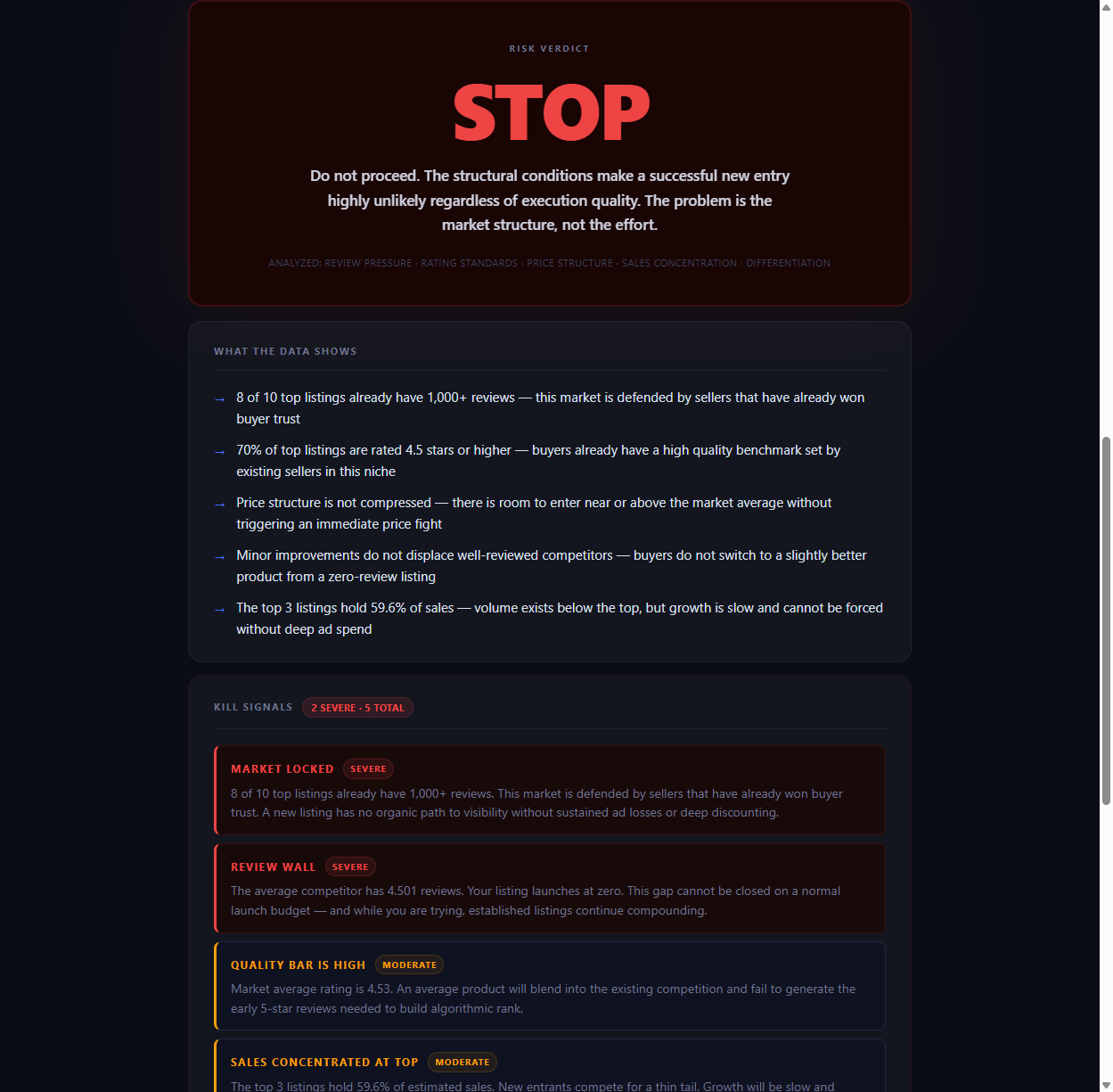
A locked market, caught before a single dollar moves. Two severe signals — Market Locked and Review Wall — are enough to trigger STOP on their own.
Most failed Amazon products were predictable before the first inventory order — the market was already locked. This free snapshot reads the structural pressure in your target niche: how dominant the existing reviews are, how tight the prices sit, and how concentrated the sales are. Run it on your top competitors before you spend anything on samples or stock.
| # | Price ($) | Reviews | Rating | Est. Monthly Sales |
|---|---|---|---|---|
| 1 | ||||
| 2 | ||||
| 3 | ||||
| 4 | ||||
| 5 |
The full Kill-or-Go tool weighs your own price, quality and differentiation against this market and returns a GO / CAUTION / STOP decision — with the exact kill signals and your next moves.
Most Amazon Sellers Don't Fail Because They Lacked Data.
They Fail Because They Chose the Wrong Product.
The typical FBA failure story does not start with bad ads or a poor listing. It starts three months earlier, when a seller looked at a keyword, saw the monthly revenue estimates, and decided to move forward without understanding what they were actually walking into.
The niche was already locked
Seven of the top ten listings had over a thousand reviews. A new listing could not compete on trust, could not outspend on PPC, and took months to discover the problem after the inventory was already paid for.
The market was a price war
Competitors were already squeezed into a narrow price band. The seller undercut to win initial sales, destroyed the margin, burned through ad budget chasing volume that never came, and exited at a loss.
There was no entry angle
The product was identical to what was already ranking. No differentiation, no quality advantage, no reason for a buyer to choose an unreviewed listing over an established one. The commodity trap is invisible until after launch.
The data tools showed opportunity. The market had none.
Keyword tools show revenue estimates. They do not tell you that three sellers control 78% of total sales in that niche. They do not tell you the review barrier will take 18 months to clear at realistic launch velocity. They show data. They do not make calls.
The Amazon FBA Product Validation Tool That Makes the Call — Not Just Shows the Data
It is not a research tool. It is a decision tool. You bring the data. It makes the call.
Analyzes competitive pressure
Calculates a weighted competition pressure score from review counts, review distribution, and average ratings across the top listings in your target niche.
Calculates entry barrier
Scores how difficult it is for a new listing to realistically compete given your planned price, quality level, and differentiation against the existing competition.
Detects 11 structural kill signals
Flags Market Locked, Review Wall, Price War Zone, Commodity Trap, Rating Ceiling, Sales Monopoly, Tight Price Compression, Quality Bar Too High, Weak Entry Angle, Unjustified Premium, and Margin Collapse Risk — independently, with severity weighting.
Returns a hard verdict
STOP. CAUTION. GO. Not a score. Not a dashboard. One clear outcome — with a plain-English explanation of what drove it and what would need to change.
Gives concrete next steps
The output includes up to five specific action steps tailored to your exact verdict and the signals that fired. Not generic advice — actions directly tied to your market data.
Shows the market snapshot
Average reviews, median reviews, price band, top-3 sales share, average rating — the six numbers that actually tell you what you're up against, laid out after every analysis.
How This Amazon Product Validation Tool Works: Three Inputs, One Hard Verdict, Ten Minutes
Enter competitor listing data
Pull the top 10 organic results for your target keyword from Amazon. Enter the price, review count, rating, and estimated monthly sales for each listing. Use Jungle Scout, Helium 10, or Seller Assistant for sales estimates. At least 5 complete rows required.
Do not skip the strong listings to make the market look softer. The tool reads market structure — bad data produces a false verdict.
Add your planned product details
Your planned selling price, your honest assessment of product quality (Weak / Average / Strong), your buyer-visible differentiation (None / Slight / Strong), and whether you plan to compete on price to win initial sales.
Answer as an external observer, not as a seller excited about the idea. Overestimating differentiation produces a falsely safe result — and you pay for that with inventory.
Get your verdict and act on it
Click Check Product Risk. The tool runs a full structural analysis and returns your verdict — STOP, CAUTION, or GO — with the active kill signals, a plain-English explanation of each, a market snapshot, and concrete next steps.
If the verdict is STOP, close the idea. If it is CAUTION, find out what would need to change. If it is GO, proceed with full awareness of what the structural conditions actually are.
Once you get a GO verdict, your first battle is visibility. Rank Blocker shows which keywords your listing can realistically rank for given your current review count — so you don't target keywords the market has already locked.
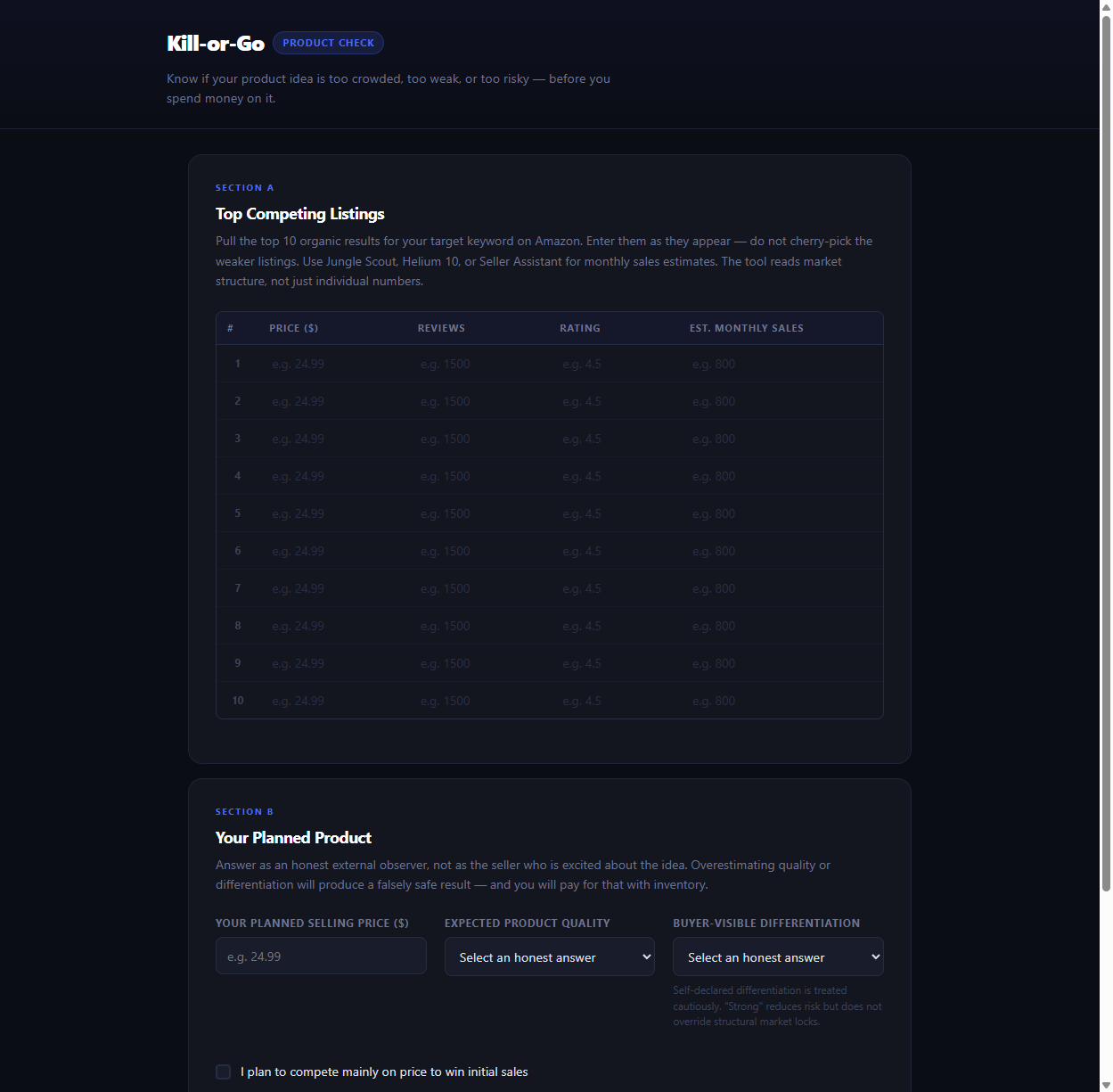
Section A: the competitor table. Section B: your product. Ten minutes of honest data entry, one hard verdict.
What STOP, CAUTION, and GO Mean in Real Business Terms
Do not proceed with this plan
The structural conditions are stacked against a new entrant and cannot be overcome by execution quality alone. Common causes: review dominance across most listings, extreme sales concentration in the top three, commodity positioning with no entry angle, price-war conditions that destroy margin before reviews can build, or a quality mismatch that makes the launch structurally untenable.
What to do: Do not order samples. Do not brief a supplier. Run the tool again with a different sub-niche, a different entry angle, or a different product. STOP is a verdict on your current plan, not necessarily on the category forever.
A path may exist — but not with your current plan
One or more structural problems make entry difficult without changing something meaningful. The tool has identified the specific tension: your differentiation is insufficient for the review barrier, your price is wrong for the competitive band, or the market has conditions that moderate-quality products cannot survive. CAUTION is conditional — it is not encouragement to proceed as-is.
What to do: Read the active signals carefully. Identify what specifically would need to change — your quality claim, your differentiation angle, your target sub-niche, or your price positioning — and run the analysis again with updated inputs before acting.
Structural conditions allow a new entry
The review barrier is manageable within a realistic launch timeline. Sales are not monopolised by two or three dominant listings. The price structure has room. Your entry angle is viable given the market conditions. GO does not mean the launch will succeed — execution still matters. It means the structural conditions do not eliminate you before you start.
What to do: Proceed with full awareness of the specific conditions in the market. GO should feel earned — if the analysis was honest, the conditions genuinely support entry.
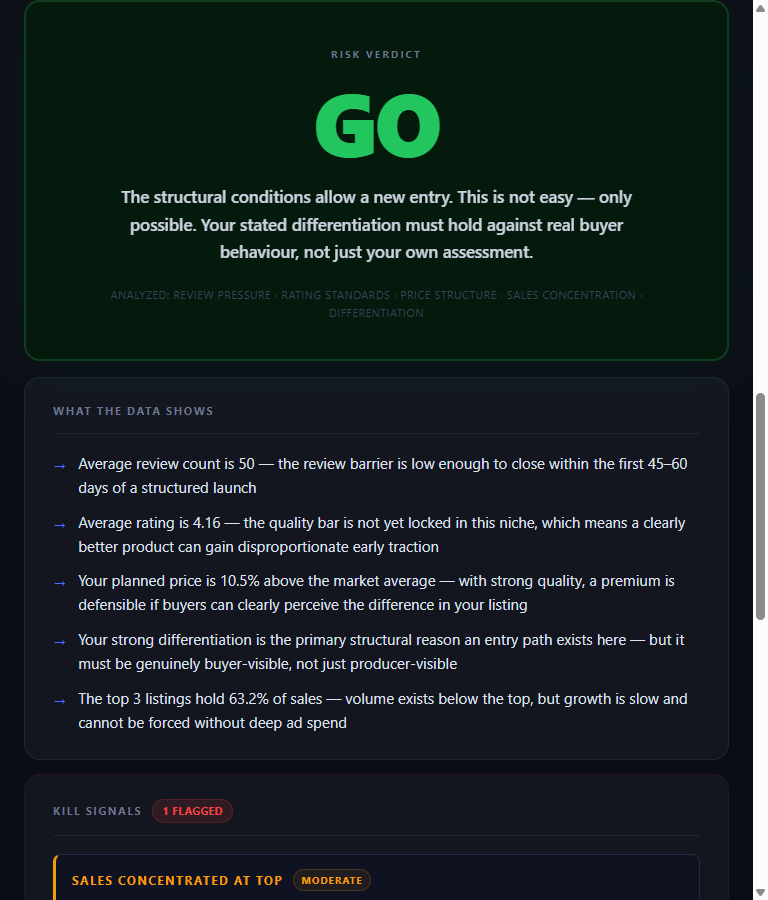
A GO verdict — not an easy market, but structurally open. One moderate signal flagged. Full reasoning and next steps included.
The verdict engine is intentionally conservative. A false GO leads to inventory orders, supplier deposits, launch costs, and months of ad spend before the structural problem becomes obvious. A false STOP just means you run the check again with a refined plan — no money lost. The tool errs toward caution. That is a feature.
This Tool Does One Thing. That Is the Point.
The Amazon seller tool market is full of dashboards, suites, and research platforms. Kill-or-Go is none of those things. It is a focused rejection filter — built to answer the one question every other tool avoids making a call on.
| Capability | Typical Research Tools | Kill-or-Go |
|---|---|---|
| Keyword volume estimates | Yes | Not the focus |
| Revenue estimates | Yes | Not the focus |
| Structural viability verdict | No — shows data, not decisions | Yes — STOP / CAUTION / GO |
| Review wall detection | Visible but not flagged | Explicitly detected and weighted |
| Price war zone detection | Not detected | Detected, with margin risk assessment |
| Sales monopoly detection | Not detected | Detected at 70%+ top-3 concentration |
| Plain-English next steps | Not provided | Up to 5 specific action steps per verdict |
| Subscription required | Usually $49–$199/month | One-time purchase only |
| Data privacy | Data sent to servers | Fully offline — nothing leaves your browser |
Kill-or-Go is not a replacement for Jungle Scout, Helium 10, or AMZScout. It is the step that comes after you find a product idea — and before you act on it. Use your research tools to find and estimate. Use Kill-or-Go to decide whether to proceed.
Built for Amazon FBA and Private Label Sellers Who Validate Before They Order
Amazon FBA beginners validating their first idea
You have a product idea, some keyword data, and a spreadsheet. You do not know if the numbers you are looking at mean this niche is actually enterable or structurally hostile. Kill-or-Go gives you a clear answer in ten minutes — before you spend money finding out the hard way.
Intermediate sellers comparing multiple product ideas
You have three or four ideas on the table and need to eliminate the obvious losers before you invest research time. Run each one through Kill-or-Go, discard the STOPs, focus your deep research on the ideas that actually have structural room.
Sellers burned by a bad product launch
You have already experienced the inventory mistake, the PPC burn, the slow launch in a locked niche. You want a repeatable framework that catches structural problems before they become expensive ones. This is that framework.
Product researchers who need a fast rejection filter
You evaluate dozens of product ideas a month. You cannot do deep research on all of them. Kill-or-Go is the triage layer — it kills the weak ideas quickly so you can spend real research time on the ideas worth investigating.
Private label sellers sourcing from Alibaba or similar
You have a supplier quote and a sample on the way. Before you place a real inventory order, run the target niche through Kill-or-Go. If the verdict is STOP, the supplier deposit is the only money you lose — not three months of Amazon fees on unsold stock.
Sellers using Jungle Scout or Helium 10
Your research tools give you the data. Kill-or-Go interprets that data structurally and makes the call your research tools are not designed to make. They work together, not instead of each other.
Validated niche — but traffic lands without buying? No-Sale Detector diagnoses exactly what stops browsers from becoming buyers on Amazon listings that already have traffic.
This Tool Has a Clear Scope. That Is Deliberate.
Kill-or-Go does not track keywords, monitor rank movements, or provide search volume data. Those tools exist and work well. This is not one of them.
There is no API, no automatic data pull, and no Chrome extension. You enter the numbers yourself. If you need automated data collection, use a dedicated scraping tool alongside this one.
Kill-or-Go analyzes current market structure at the moment you enter the data. It does not predict seasonal trends, forecast demand changes, or analyze historical velocity. Google Trends and Helium 10 cover that.
This tool does not suggest products to sell, find suppliers, or recommend niches. You bring the idea; the tool tells you whether it is structurally viable.
The verdict engine is deterministic and rule-based. Every output is derived from the data you enter, not generated by a language model. If you want AI summaries of market conditions, this is not the right tool.
Every Output Is Built to Help You Make One Decision
11 Kill Signal Checks
The tool runs every analysis on every entry: Market Locked, Review Wall, Price War Zone, Commodity Trap, Rating Ceiling, Sales Monopoly, Tight Price Compression, Quality Bar Is High, Weak Entry Angle, Unjustified Premium, Margin Collapse Risk. Severity-weighted. Plain-English descriptions. No score to interpret.
Hard Verdict — Not a Score
Most tools give you a number and leave the decision to you. Kill-or-Go makes the call. STOP, CAUTION, or GO. The verdict is deterministic — same data always produces the same outcome. No black-box randomness, no AI variability.
Plain-English Signal Explanations
Each active kill signal includes a description specific to your data — not generic advice. "The average competitor has 4,200 reviews. At a realistic launch velocity of 30 reviews per month, reaching competitive review parity takes over 11 years." That level of specificity.
Market Snapshot
Six market metrics calculated automatically from your inputs: average reviews, median reviews, average rating, price band, top-3 sales share, and sales concentration level. The numbers that actually tell you what the market looks like.
Concrete Next-Step Guidance
Up to five specific action steps, tailored to your exact verdict and the signals that fired. Not "do more research." Specific actions tied to your specific market conditions.
Complete Offline Operation
Download once, use forever with no internet connection. Your competitor data, your product details, and your verdict never leave your browser. No backend, no telemetry, no account required at any point.
One-Time Payment, Permanent Access
No monthly fee. No annual renewal. No tiered pricing that locks critical features behind a higher plan. One payment, and the tool is yours permanently — including any future updates distributed to existing customers.
Works Everywhere, Instantly
Unzip the download, open index.html in Chrome, Edge, Firefox, or Safari. Works on Windows, macOS, and Linux. No installation, no configuration, no waiting.
Amazon FBA Product Validation Tool — Frequently Asked Questions
No. Kill-or-Go is a one-time purchase. You download a zip file, open
index.html in any modern browser, and the tool runs locally.
There is no login, no account, and no recurring fee of any kind.
No. The verdict engine is deterministic and rule-based. Every output is calculated directly from the data you enter, using a fixed set of structural analysis heuristics. The same data always produces the same verdict. There is no language model, no generated content, and no black-box scoring.
Yes, completely. After download, the tool requires no internet connection. Everything runs in your browser. Your competitor data and product details never leave your device — there is no backend, no API call, and no data collection.
Jungle Scout and Helium 10 are research tools — they find products and estimate revenue. Kill-or-Go is a decision tool — it takes that same data and makes the structural viability call your research tools are not designed to make.
The typical workflow: use Helium 10 to find a keyword with decent volume and revenue estimates. Pull the top 10 listings. Enter them into Kill-or-Go. Get a verdict before you brief a supplier. They work together — Kill-or-Go is the step that runs after your research and before your money moves.
STOP: Do not proceed. Structural conditions make this niche hostile to a new entrant. The problem cannot be solved by executing harder — it is baked into the market structure.
CAUTION: A path may exist, but not with your current plan. The tool has identified what is wrong. Change your differentiation angle, your quality level, your pricing, or your sub-niche, then re-run the analysis.
GO: Structural conditions allow a new entry. Review barriers are manageable, sales are distributed, and your angle is viable. GO is not a guarantee of success — it means the market structure does not eliminate you before you start. Execution still matters.
Yes. If you can pull a list of the top 10 Amazon listings for a keyword and note their price, review count, rating, and estimated monthly sales — which takes about five minutes in Jungle Scout or Helium 10 — you have everything the tool needs. The inputs are straightforward, the output is plain English, and the verdict requires no interpretation.
Primarily yes. Kill-or-Go is built around the private label pre-launch decision: is this niche structurally safe to enter with a new product? It is also useful for wholesale sellers assessing category competitiveness, and for arbitrage sellers who want to understand how dominant existing listings are before they list into a category.
No. Kill-or-Go does not find products, estimate revenue, track keywords, or suggest niches. It analyzes structural viability for a niche you have already identified. Use your research tools to find candidates. Use Kill-or-Go to decide which candidates are worth pursuing.
A false GO — telling you a market is safe when it is not — leads to inventory orders, supplier deposits, launch costs, and months of ad spend before the structural problem becomes obvious. The cost is real: $3,000–$15,000 for a typical failed launch.
A false STOP — telling you to avoid a market that was actually enterable — costs nothing. You run the analysis again with a refined plan or a different idea.
Given that asymmetry, the tool errs toward caution. GO is hard to earn deliberately.
You receive a zip file containing four files: index.html, style.css,
app.js, and README.txt. Unzip the folder anywhere on your computer,
open index.html in Chrome, Edge, Firefox, or Safari, and the tool works immediately.
No installation, no configuration, no internet required.
Yes. The tool runs in any modern browser — Chrome, Edge, Firefox, or Safari — on Windows, macOS, and Linux. No operating system limitations.
Because the tool does one thing and does it well. There is no ongoing data pipeline to maintain, no servers to run, no AI model to update. The verdict engine runs locally in your browser. A subscription model would be charging you recurring fees for infrastructure that does not exist. One-time payment is the only model that makes sense for a tool like this.
Kill-or-Go is purpose-built for private label sellers who need to validate whether a niche is structurally safe to enter before they source inventory. Unlike general research tools that show keyword data and revenue estimates, Kill-or-Go runs a structural market analysis — review walls, price compression, sales monopolies — and returns a hard STOP, CAUTION or GO verdict. It is the only offline, one-time purchase Amazon FBA product validation tool designed specifically for this decision.
Other Amazon product validators typically use human reviewers, take up to one week per product, and charge per-product fees. Kill-or-Go is a fully automated, deterministic tool that runs instantly in your browser, costs a single one-time payment for unlimited use, and runs completely offline — your data never leaves your device. It is also the only validator that explicitly detects and names structural kill signals like Review Wall, Price War Zone, Sales Monopoly, and Margin Collapse Risk.
A niche is structurally too competitive when the review barrier cannot be closed within a realistic launch timeline, when three or fewer sellers control the majority of sales, when the price band is so compressed that a new entrant cannot operate at margin, or when the product category offers no viable differentiation angle. Kill-or-Go checks all of these conditions automatically and tells you exactly which ones apply to your target niche — before you spend money finding out the hard way.
No — the free snapshot only describes how crowded and locked the market is (SATURATED, MIXED, or OPEN). The full Kill-or-Go tool adds your own price, quality, and differentiation to return a GO / CAUTION / STOP decision with the specific kill signals and your next steps.
Stop Guessing. Start Filtering.
One bad Amazon product launch costs more than this tool many times over. Supplier deposits. Sample orders. Inventory that does not sell. PPC budget burned into a niche that was already locked before you arrived. Kill-or-Go catches structural problems before they become expensive ones.
One-time payment · Instant download · No subscription
Get Kill-or-Go Now →- Download a zip file, open index.html, start immediately
- Works on Windows, Mac, and Linux — any modern browser
- Fully offline — your data never leaves your device
- No subscription, no renewal, no hidden tiers
- Pairs with Jungle Scout, Helium 10, and Seller Assistant
This tool is a decision-support aid based on structural market heuristics. Verdicts do not constitute financial or business advice. All sourcing and investment decisions remain your own responsibility.